In the last 2 years, more deprived areas have seen higher spending power increases. This partly addresses a trend that has seen that spending power fall more sharply in those same areas since 2011/12.
Authorities receiving additional Social Care funding has been the primary driver for this slight reversal. Once Social Care funding dries up, the trend will revert to favouring authorities with wealthier tax bases and those less reliant on government grants.
Limited effort has been made to redistribute funding for district councils, which typically provide services such as planning, waste collection and housing.
Successive governments have used Council Tax rises to replace central government funding. This means that deprived areas lose out because they don’t have wealthy communities to tax.
There are consequences to the government’s decision to fund councils this way. Whilst they acknowledge calls from the sector for a fair funding review, this is yet to happen.
To illustrate this, let’s look at the authorities assessed as the least deprived (Wokingham) and the most deprived (Knowsley)*.
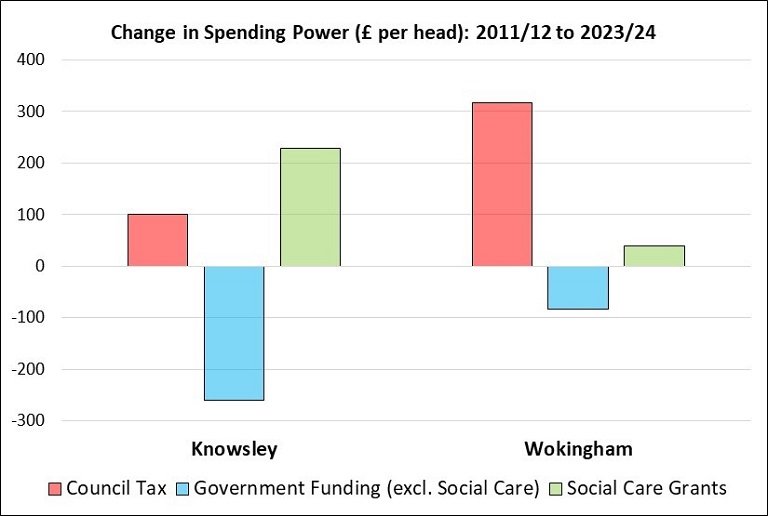
The chart shows changes in Spending Power per head for Knowsley and Wokingham between 2011/12 and 2023/24.
Over this period, cuts to central government funding (shown in blue) have hit the Knowsley much harder. While these cuts were roughly equal universally in percentage terms, deprived areas (which are more reliant on grants), bore the brunt.
In contrast, increases in the proportion of funding coming from council tax (shown in red), have benefited more affluent areas such as Wokingham.
Is this really levelling up?
In the past two years significant additional Social Care Grants (shown in green) have redressed the balance to some degree. Although this shows early signs of “levelling up”, this level of funding increase is unsustainable. Without a return to a fair funding formula, deprived areas should expect to fall further behind.
The current funding approach, with its reliance on regressive Council Tax falls short across the board. Knowsley, with its low Council Tax base will struggle to make income whilst Wokingham will rely increasingly on its tax payers to fund services.
So how does this affect your authority? What needs to change? We believe a Fair Funding review is needed as a matter of urgency.
Note: We have chosen Knowsley and Wokingham due to the fact that they were assessed as having the highest and lowest needs respectively when funding formulae were last used in 2011/12. In terms of Indices of Multiple Deprivation, Knowsley is assessed as the second most deprived area in England (Blackpool is first) and Wokingham is assessed as the least deprive area in England.
If you would like more information on our Local Government Finance Settlement model from which the analysis was derived please contact us.
Contact:
Email: enquiries@lgimprove.com
Tel: 0117 463 6962